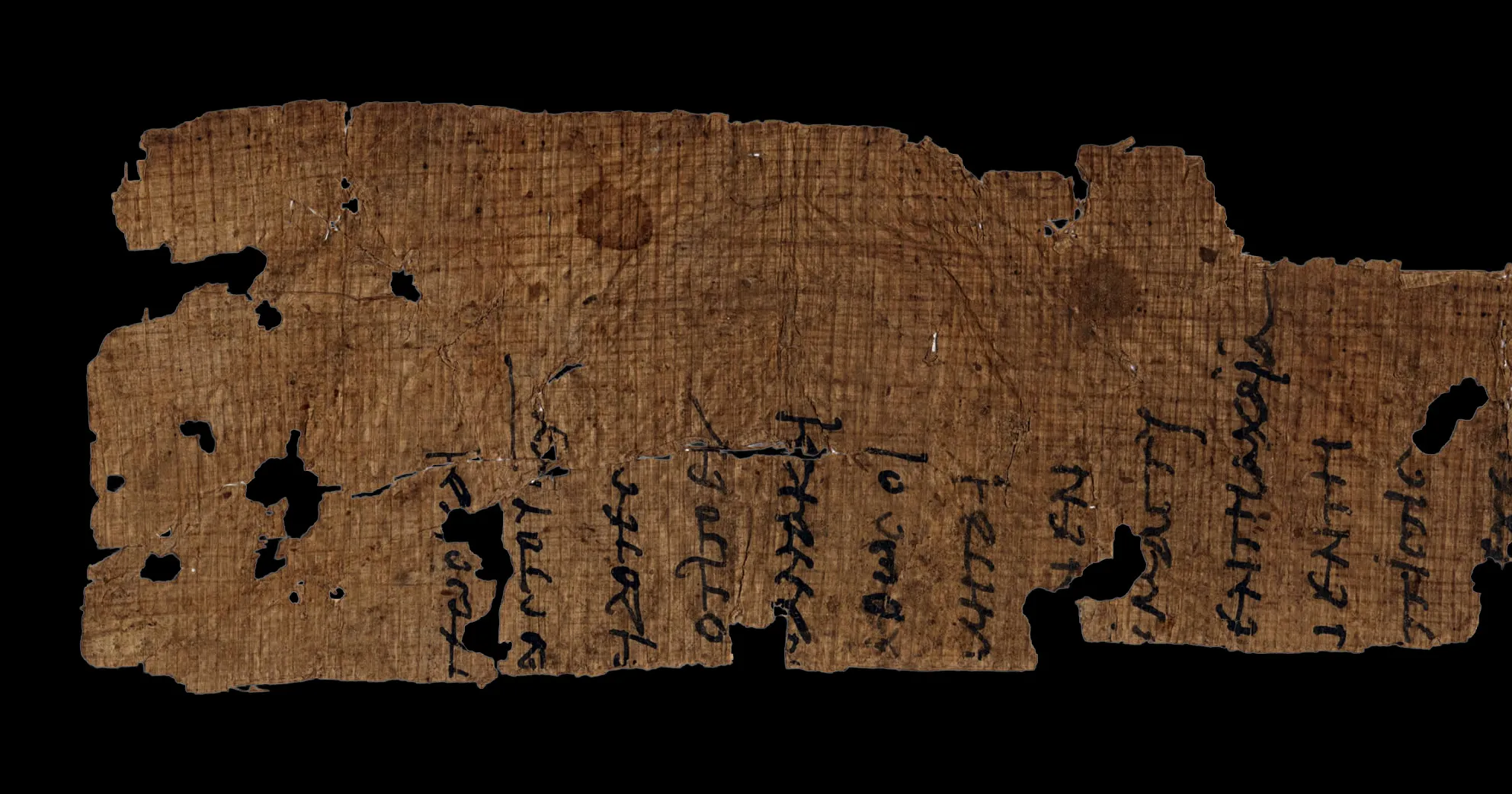
_recto_1_Thess_1,_1-2,_1.jpg)
For a class at our church, we recently worked our way through Rafael Rodriguez’ book The First Christian Letters, a study of 1 and 2 Thessalonians. 1 Thessalonians is believed to be the earliest of Paul’s letters (some place Galatians earlier), making it the earliest or one of the earliest books of the New Testament (many would place James earlier). The First Christian Letters has a chapter exploring the question of whether Paul wrote 2 Thessalonians. Debates over Pauline authorship don’t get much attention in our churches; at least in the circles I grew up in, we’re much more likely to simply assert that, since the letters identify Paul as the author, then he’s the author.
| Pauline | Disputed |
|---|---|
| Romans | Ephesians |
| 1 Corinthians | Colossians |
| 2 Corinthians | 2 Thessalonians |
| Galatians | 1 Timothy |
| Philippians | 2 Timothy |
| 1 Thessalonians | Titus |
| Philemon |
Of the 13 letters attributed to Paul in the New Testament, seven are widely accepted as authentic. Six are disputed – accepted by some scholars, rejected by others, with some more disputed than others. The pastoral epistles (1 Timothy, 2 Timothy, and Titus) are argued to reflect a more structured, more socially conservative church organization and simply sound different than Paul’s other letters. Colossians is said to have a more cosmic view of Jesus’ being and work and a different way of engaging with the letter’s opponents. Ephesians lacks personal touches, is argued to draw from other letters (especially Colossians), and has some uncharacteristic vocabulary.
Since The First Christian Letters is a study of 1 and 2 Thessalonians, let’s focus on the debate of the authorship of 2 Thessalonians. The two letters sound very, very similar in places: 1
| 1 Thess. 1:1 | 2 Thess. 1:1-2 |
|---|---|
| Paul and Silvanus and Timothy. To the assembly of the Thessalonians in God the Father and the Lord Jesus Christ. Grace and peace to you. | Paul and Silvanus and Timothy. To the assembly of the Thessalonians in God our Father and the Lord Jesus Christ. Grace and peace to you from God our Father and the Lord Jesus Christ. |
Or, later on:
| 1 Thess. 2:9 | 2 Thess. 3:8 |
|---|---|
| For you remember, brothers and sisters, our labor and toil: night and day we were at work so that we would not be a burden on you in any way; we proclaimed to you the gospel of God. | Instead, by labor and toil, night and day we were at work so that we would not be a burden on you in any way. |
The identical wording is striking: either Paul and his companions wrote 2 Thessalonians very quickly after 1 Thessalonians (possibly even with a copy of the letter to refer to), because the issues that promoted 1 Thessalonians were still going on, or a later author wrote in Paul’s name, trying to mimic Paul using 1 Thessalonians as a reference.
| 1 Thess. 5:1-3 | 2 Thess. 2:3-5 |
|---|---|
| But you do not need to have anything written to you, brothers and sisters, concerning ages and seasons, for you yourselves are well aware that the day of the Lord is coming like a thief at night. Even as they say, “Peace and safety,” then destruction suddenly comes upon them, the way labor comes to a pregnant woman, and they will have no means of escape. | Let no one deceive you in any way; the day of the Lord will not come until the rebellion comes and the man of lawlessness is revealed—that is, the son of destruction… Do you not remember that I was saying these things to you when I was still with you? |
And yet there are apparent differences between the two books. 1 Thessalonians tells its readers not to worry because they know that Jesus will come “like a thief in the night” or sudden labor pains – suddenly and apparently with no warning. 2 Thessalonians tells its readers not to be deceived because they know that Jesus’ coming will be preceded by visible signs such as “the rebellion” and the “man of lawlessness.”
There are further similarities and differences we could get into. And some scholars argue that the language like 2 Thess. 2:2, “a letter allegedly from us,” is the pseudonymous author protesting too much.
More broadly, this question of Pauline authorship gets into the topic of apocrypha and pseudepigrapha. The Apocrypha (from the Greek word for “obscure” or “concealed”) are the books of the Bible that aren’t recognized by our churches but are recognized by other churches (primarily Catholic and Orthodox):
- Tobit
- Judith
- Baruch
- Letter of Jeremiah
- Sirach (Ecclesiasticus)
- Wisdom of Solomon
- 1 and 2 Maccabees
- 1 and 2 Esdras
- 3 and 4 Maccabees
Even among these churches, there are differences: the Orthodox Church accepts 1 and 2 Esdras, while the Catholic Church doesn’t. These books are sometimes called Deuterocanonical (“second canon”). Within our churches, we don’t recognize them as divinely inspired, but they may still have value and may still merit study. 1 and 2 Maccabees, for example, explain some of the history of Judaism in the period between the Old and New Testament. The Wisdom of Solomon is, I’m told, quite beautiful, and Paul’s writing suggests that he was familiar with it and used it.
Pseudodepigriapha (“false writings”), by contrast, are writings that are generally recognized as not written by their purported authors. We could give many, many examples here:
- Assumption of Moses
- 1 and 2 Enoch
- Jubilees
- Letter of Aristeas
- 4 Ezra
Or, among Christian writings:
- Gospel of Peter
- Paul’s Letter to the Laodiceans
- Gospel of Barnabas
- Acts of Paul
- 3 Corinthians
For example, the book of Enoch, written between the Old and New Testaments, claims that Enoch, who went to heaven in Genesis 5 without dying, has now returned to earth to reveal (the root meaning of “apocalypse”) what’s going on in ultimate reality. It has stories of demons and angels and Nephilim. There’s even a comment in there criticizing people who write texts under their own name – so we think that the author(s) of Enoch were in a doctrinal argument with Sirach, whose work shows up in the Apocrypha, and they slipped in a little jab at him while claiming to be writing as this figure from thousands of years ago. Unlike the Apocrypha, which are accepted as canonical by some churches, almost no one accepts these pseudepigrapha as canonical. The books of Enoch can certainly help us understand the thinking and beliefs of Jews in the time period leading up to the New Testament, but hardly anyone believes that Enoch actually wrote them or considers them inspired Scripture.
There were a whole lot of forgeries and pseudepigrapha being written within the Greco-Roman world at the time of the New Testament. And so they started devoting some effort to identifying these, calling them out. For example, the physician Galen was upset about seeing a forged book in his name, so he wrote a book to counter it. Julius Africanus, a 2nd and 3rd C. Christian scholar, wrote to Origen expressing doubt about the story of Susannah in the Greek versions of Daniel. (We don’t accept this story in our Bibles.) His reasoning was that it depended on two puns in Greek – so it couldn’t have been part of the original Hebrew story (puns don’t translate). 2
In 3 Corinthians, two teachers, Simon and Cleobius, were attracting lots of attention but were promulgating false doctrine. So someone supposedly wrote to Paul, asking for him to intervene, and Paul wrote back:
Paul, the prisoner of Jesus Christ, to the brothers and sisters at Corinth—greeting! Being in many afflictions, I marvel not that the teachings of the evil one had such rapid success. For my Lord Jesus Christ will quickly come, since he is rejected by those who falsify his teaching. For I delivered to you first of all what I received from the apostles before me who were always with Jesus Christ, that our Lord Jesus Christ was born of Mary of the seed of David, the Father having sent the Spirit from heaven into her that he might come into this world and save all flesh by his own flesh and that he might raise us in the flesh from the dead as he has presented himself to us as our example. And since human beings are created by their Father, for this reason they were sought by him when they were lost, to become alive by adoption… . And whoever accepts this rule which we have received by the blessed prophets and the holy gospel, shall receive a reward, but for whomsoever deviates from this rule fire shall be for him and for those who preceded him therein since they are Godless people, a generation of vipers. Resist them in the power of the Lord. Peace be with you. 3
There are real similarities here with Paul’s language, but the letter also has significant differences. Few, if any, believe that Paul wrote it, and almost no one accepts it as canonical.
What do we do with all of this? In the church circles that I grew up in, we would automatically reject any suggestion that Paul didn’t write all 13 of the New Testament letters that bear his name. I’d like to spend some more time talking about the argument that he maybe didn’t, though. In Internet circles, this is sometimes called steelmanning. A straw man is the logical fallacy where you give a weak version of your opponent’s argument to make them look bad. Steelmanning is the opposite – it’s where you instead give a strong version of an opponent’s argument to help you better understand and counter it. 2 Thessalonians talks about the judgment coming on those who “refused to love the truth” (2 Thess. 2:10 ESV). This of course ultimately refers to Jesus, who is the truth; but, if we’re supposed to love the truth, then I believe that part of loving the truth is seeking the truth, acknowledging that we might be wrong, being willing to engage with arguments that may challenge our beliefs.
As you saw from the lists above, there was a lot of pseudepigrapha going on. Modern readers automatically view pseudepigrapha as deceptive and dishonest, but some scholars argue that, because the ancients didn’t think of copyright and intellectual property the same way we do, pseudepigrapha could be accepted. The argument is that an associate or disciple of Paul could be recognized as being in Paul’s tradition and could therefore write in his name without it being viewed as deceitful. Or maybe a community of faith that was shaped by Paul’s teachings wrote down what Paul taught them. (This view is not universally accepted; for a much more in-depth discussion, see the Christian Thinktank’s “Could the New Testament Letters be cases of Pseudonymity?”.)
Whether or not this view is accurate, I trust the Bible, not because I follow Paul – 1 Cor 1:12 says not to say that! – but because it’s inspired by the Holy Spirit. And the Holy Spirit can inspire a pseudonymous disciple of Paul or a community of faith that was shaped by Paul just as easily as he can inspire Paul. For example, consider other books of the New Testament:
- Matthew
- Mark
- Luke
- John
- James
- 1-3 John
- Jude
- Revelation
We’re actually not certain who wrote these books, either. The Gospels are anonymous. We have traditions, sometimes with good reason (for example, Luke is identified by comparing the named companions of Paul in Acts with the companions that Paul identifies in his letters), but those traditions aren’t Scripture. 1-3 John, Jude, and Revelation name their authors, but we don’t know if the John who wrote 1-3 John is the same John who wrote Revelation, or if this John was the apostle, or if Jude was the brother of Jesus.
I like the traditions! I like the idea that Matthew, Mark, Luke, John were written by Matthew, Mark, Luke, and John. And I believe it’s rational and reasonable to trust that the early church passed down accurate traditions about their authorship. But my faith doesn’t depend on these traditions. If the gospels were instead written by Peter, Paul, John, and Ringo, there’s still good reason to believe them – their internal character, the changed lives of the first believers, testimony from sources such as Paul’s letters, the compelling picture the gospels draw of Christ.
Similarly, many of the Old Testament are anonymous. (Prior to the spread of Greco-Roman culture, the Israelite and Jewish people didn’t prioritize tracking authorship as much.) For example, the Wisdom of Solomon implies but doesn’t claim to have been written by Solomon; the ancients had no problem accepting that it was written by “friends of Solomon” in his style. Ecclesiastes identifies its author only as the Preacher; this may have been Solomon writing under a pen name, or it may have been a later philosopher (perhaps one who temporarily adopted a persona like Solomon’s for literary purposes). This in no way impugns its inspiration or authority.
What’s the point of this?
First, if we love the truth, then I believe there are times we need to test our understanding of the truth and learn what we can.
Second, not doing so can damage our faith. I’ve previously discussed the example of Bart Ehrman, one of the world’s better-known New Testament scholars. He grew up fundamentalist or evangelical then went to seminary, where he wrote a research paper on the apparent contradiction of Mark 2:26. (Jesus talks about David’s actions “when Abiathar was high priest,” but Abiathar was not the high priest at that event.) He got back a comment from his conservative professor: “Maybe Mark was just wrong.” This threw him into a tailspin; he dramatically revised his view of the authority of Scripture and, over subsequent years, ended up leaving the faith altogether (due, he says, to the problem of evil).
Or consider Rachel Held Evans’s struggles that she narrates in Inspired:
It was as if the Bible had turned into an unsettling version of one of those children’s peekaboo books. Beneath the colorful illustration of Noah’s Ark was – surprise! – the violent destruction of humanity. Turn the page to Joshua and the Battle of Jericho and – peekaboo! – it’s genocide… Gone was the comforting storybook of my childhood, the useful handbook of my adolescence, and the definitive answer book of my college years. The Bible of my twenties became a stumbling block, a massive obstacle between myself and the God I thought I knew…
Friends, professors, and Sunday school teachers rushed to offer explanations, often referring me to Gleason Archer’s massive Encyclopedia of Bible Difficulties, a five-hundred-page tome that promised answers to all the Bible’s most challenging puzzles, but which proved less than helpful to a reluctant skeptic previously unaware half of those puzzles existed in the first place. The harder my fellow Christians worked to minimize my objections, the more pronounced those objections became. Beneath all the elaborate justifications… I sensed a deep insecurity. There was a move-along-nothing-to-see-here quality to their arguments that only reinforced my suspicion that maybe the Bible wasn’t magic after all, and maybe, deep down, they knew it… Then when a pastor friend asked me what personal sins might have triggered my questions – “sexual immorality, perhaps?” – I saw my journey through these doubts would be a lonely one. (p. xvii-xvii)
By refusing to even entertain these questions and challenges, by not acknowledging the possibility that God can inspire in ways different than we thought, we risk opening ourselves or others to struggles like Ehrman’s and Evans’.
Rob Bell describes our faith as a trampoline. Doctrines are like the trampoline’s springs – “We can take it out and examine it. Discuss it, probe it, question it. It flexes, and it stretches” (Velvet Elvis, p. 22). By contrast, he saw a video of someone who said, “If you deny that God created the world in six literal 24-hour days, then you are denying that Jesus ever died on the cross.” Bell describes the approach of this lecturer:
For him faith isn’t a trampoline; it’s a wall of bricks. Each of the core doctrines for him is like an individual brick that stacks on top of the others. If you pull one out, the whole wall starts to crumble. It appears quite strong and rigid, but if you begin to rethink or discuss even one brick, the whole thing is in danger. Like he said, no six-day creation equals no cross. Remove one, and the whole wall wobbles. (p. 26)
I don’t want our faith to be brickworld. I want people to follow Christ, not to follow a particular view of who wrote which book of the Bible. Instead of teaching, “you have to have a particular understanding of who wrote the Bible, or you’re not a real Christian” – or the age of the earth, or how we understand gender and sexuality, or whatever the controversy of the day is – I’d rather teach, “You have to follow Christ! And this is the best way I know to follow Christ, and so it’s important!” But, as Paul wrote in Phil. 3:15, “Let those of us who are mature think this way, and if in anything you think otherwise, God will reveal that also to you.”
To the best of my understanding, there are lots of good reasons to trust in Pauline authorship. Differences in style, language, or content can be explained: Paul often wrote with others – 2 Thessalonians is by Paul and Silvanus and Timothy. Paul wrote using a scribe, or amanuensis. Paul himself may well have grown and changed in how he thought and communicated. And we’re reading other people’s mail: the New Testament letters to specific people for specific circumstances – we’re going to find some differences. But, even if I’m wrong on all this, it’s still the Word of God - just not the Word of God I expected. But I already knew that!
Rachel Held Evans quotes Peter Enns (p. xx):
What if the Bible is just fine the way it is?… Not the well-behaved everything-is-in-order version we create, but the messy, troubling, weird and ancient Bible that we actually have?
Evans died tragically in 2019 at age 37 from an allergic reaction to medication. It wouldn’t surprise me if, now that she sees face to face, now that she knows fully as she is fully known, she realizes, “I got some things wrong,” and God tells her, “That’s okay, I know that you love me, and you’re covered by my grace and my Son’s blood.” But I fully expect that, once I see face to face and know fully as I am fully known, I too realize, “I got some things wrong,” and God tells me, “That’s okay, I know that you love me, and you’re covered by my grace and my Son’s blood.” In the meantime, I look at how people like Evans and Enns wrestle with Scripture, treating it with full seriousness as the Word of God, rather than satisfying themselves with superficial answers that defend a particular view of its reliability but don’t really engage with it, and I can learn something from them.
In The First Christian Letters, Rodriguez concludes his discussion of 2 Thessalonians’ authorship by saying, “Questions about authorship are historical questions, while questions of canonicity are theological questions” (p. 131); a book may be canonical and inspired by God even if its authorship is different than we thought. He explains why he believes Paul wrote it but continues:
I don’t think the church was wrong to include 2 Thessalonians in the New Testament, even if I agreed that 2 Thessalonians was written by someone else, some years after Paul’s death…
But the church is wrong in a different way. We might not excise 2 Thessalonians from the Bible, but we excise it from our study of the Bible, from our preaching, and from our understanding of being the people of God in the world. This is not an accusation; it is a confession (p. 131).
Rodriguez explains that much of the reason he wrote The First Christian Letters was because he noticed he had been neglecting 1 and 2 Thessalonians. And much of the reason I wanted to organize a church class on them was because I realized that the churches I’ve been in have neglected Thessalonians: outside of “pray continually,” welfare debates, or speculation about the end times, I don’t remember ever hearing the letters preached or studied. This touches on what I’d said about Evans and Enns – there’s more than one way to fall short of truly honoring Scripture as the Word of God.
We talk about Scripture’s authority, its reliability, its inerrancy or infallibility. And it’s good that we do. But these are beliefs about Scripture. To truly treat the Bible as the Word of God, it’s not enough to hold to a high doctrine about it. We need to study it, loving God with our whole mind. We need to meditate over it, allowing it to fulfill its role as the Word of God by letting God speak to us through it. We need to read all of it, receiving “the whole counsel of God” instead of just those portions that are easy and familiar. We need to wrestle with it, wrestling with God instead of staying with what’s comfortable and safe. We need to submit to it, shaping our lives by what it teaches rather than cherry-picking those portions that support what we want. And we need to allow ourselves to be challenged, as long as the effect of those challenges is to bring us closer to God the Father and our Lord Jesus Christ.
Footnotes
-
Taken from p. 119-123 of The First Christian Letters. The translation used here is Dr. Rodriguez’ own. ↩
-
These examples are taken from Christian Thinktank’s “Could the New Testament Letters be cases of Pseudonymity?” ↩
-
The First Christian Letters, p. 115-116 ↩