I grieve over the political polarization of our country.
There are any number of illustrations you could use to demonstrate our political divisions.
For example, Iyengar et al. shared that, in 1960, 5% of Republicans and 4% of Democrats said they would be “displeased” if their child married outside of their political party. By 2020, 38% said they’d be upset or somewhat upset.
Iyengar et al. also found that cross-party negative sentiment jumped even as negative sentiment across religious or racial divisions plummeted:
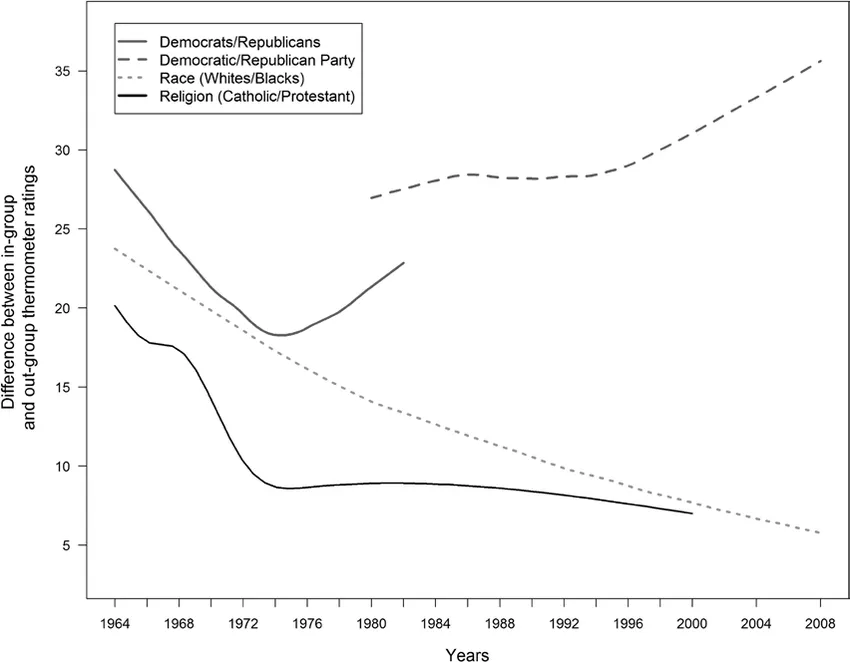
They found that “affect” – the negative emotions that members of one party felt toward another – predominated over ideological or policy differences: “Using data from a variety of sources, we demonstrate that both Republicans and Democrats increasingly dislike, even loathe, their opponents.”
My favorite illustration of partisanship, though, is this visualization from Clio et al. demonstrating polarization in Congress: how often members of each party voted across the aisle to advance legislation sponsored by a member of the other party over the last 75 years:
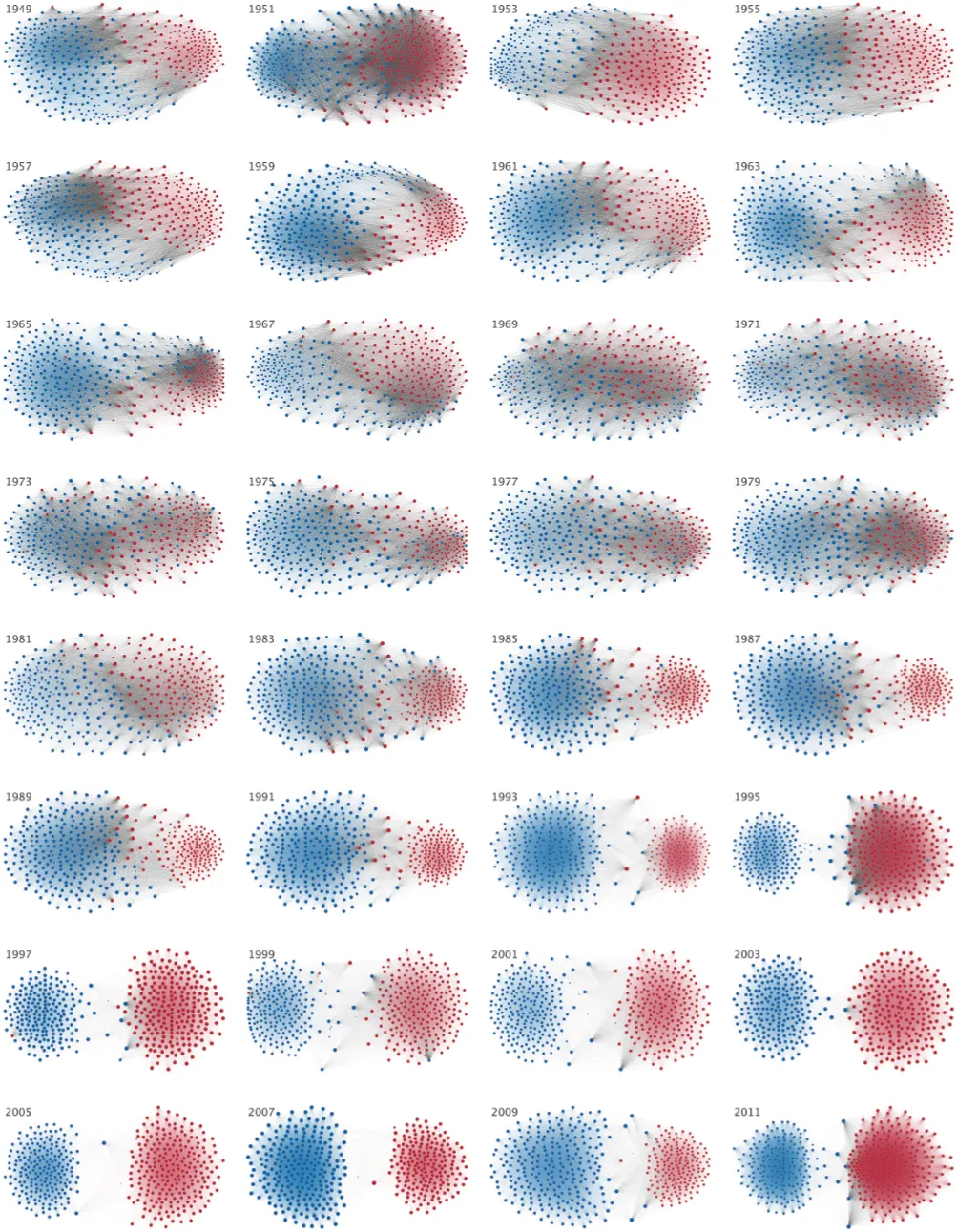
Part of this shift is that the years immediately after World War II were a period of unusual political consensus within the country. We could certainly present examples of ugly polarization from earlier in our history: congresspeople fighting duels, bludgeoning each other with canes in the Capitol building, and so on. We fought a literal Civil War in the 19th century. But rhetoric of a “civil war” or “national divorce” has ticked upward now, too.
Go on Twitter/X or Facebook and you’ll see this trend playing out: so much of the political commentary that I see is just each side calling the other stupid, ignorant, dishonest, corrupt, or outright evil. (I thought about adding some examples here, but going into the political sections of Facebook or Twitter/X tends to make me feel like I’m wading through muck.)
How did we get here?
I’ve heard any number of suggestions:1
- The constraints of traditional media meant that Americans’ access to information was filtered through a limited number of voices, so we at least had broad consensus on the facts (even if we disagreed over what to do about it); the Internet allows a proliferation of perspectives, stories, and voices, such that we hardly seem to be inhabiting the same reality.
- The rise of social media in particular has further pushed us into bubbles and echo chambers and has systematically rewarded the most extreme opinions and the opinions arousing the most fear or anger (those are the ones most likely to go viral).
- The Internet in general has a paradoxical flattening effect on our discourse: everyone is always a tap or click away, so we can gain no distance and solitude from opposing voices, while the loudest and most extreme voices can reach everywhere and dominate every conversation.
- The end of the fairness doctrine was a win for free speech, but it meant that radio networks were no longer obligated to give equal time to opposing views; although a win for free speech, this led to commentators like Rush Limbaugh (and, later, Tucker Carlson and Rachel Maddow), who, by their own words, provide “entertainment,” to significantly shape political opinions - and presenting nuanced, balanced explorations of the issues is simply less entertaining than rhetoric with a side of bombast confirming your prior beliefs.
- The spread of primary elections, which are “unusual globally”, during the 20th century represented more direct democracy than political parties choosing candidates, but these lower-turnout, party-specific elections meant that the most motivated voters (who are probably the most extreme) had “outsized influence.”
- Previously, politicians who got too extreme risked losing in the general election; now, thanks to the “big sort” and continued partisan gerrymandering, most seats are safe in the general election, and politicians worry more about getting outflanked by more extreme opponents in the primaries.
- The decline of institutions, observed in so many aspects of American society, meant that political parties, who traditionally were more interested in a stable and functioning government, were less able to reign in their more extreme members.
- Campaign finance reform, in a well-intentioned effort to reduce the impact of big money on politics, meant that politicians used the new powers of the Internet to reach out to small-dollar donors, with unintended effects: big-dollar donors have some interest in a stable and functioning government, which requires some amount of cross-party cooperation, while the easiest way to collect small-dollar donations is with attention-grabbing partisan antics. It also further weakened the political parties.
- The decline of local newspapers and rise of cable TV and Internet news means that people are paying less attention to local politics, which are often less polarizing and more about finding solutions to practical issues, and paying more attention to issues of national division.
- The decline of religion has caused people to transfer their need for meaning, purpose, and moral clarity to the political sphere.
- More tentatively, the decline in Christianity in particular may have left a “Christian penumbra,” in which some aspects of Christianity and a Christian-infused culture – moralism, judgment, a vision of the world as a battleground between good and evil – remained in a distorted and harmful form when separated Christianity’s broader tapestry of redemption, forgiveness, spiritual rather than physical foes, and self-sacrificing love.
What do we do about it?
I find the question of how we got here to be endlessly fascinating, and most of these topics could fill an article or book by themselves. It is, however, mostly irrelevant. For example, if I could wave a magic wand and reform our system of primary elections, I would. But I cannot, and although I appreciate the work that groups like RepresentUs is doing, it’s difficult for me to argue that you or I, personally, should work toward that, amid all the world’s many needs and worthy causes. The more relevant question is, where do we go from here? From my perspective, we have but three options:
- Fight. Recognize that we are good, and our opponents are evil, and do all that we can to stop them. Maybe the next election really will be the most important in our lifetime, the one in which we stop those who will surely otherwise destroy our country, the one in which we can finally gain enough political clout to pass the laws that will make the righteousness of our cause shine like the day. Our opponents persist despite all our previous Facebook and Twitter/X and Instagram posts, but maybe our next post will finally move the needle. Where our opponents are stupid or ignorant, we can lecture and correct them. Where they are dishonest or corrupt, we can punish and constrain them. Where they are evil, we can destroy them.
- Stop. Abandon the political arena. Focus our energies on our families, our communities, and our churches.
- Change. Learn to disagree better.
Option two has a lot to recommend for it. I know and respect people who’ve adopted it completely, and I think many of us would benefit if we spent less time as one of hundreds of millions of political voices and more time showing love to those around us. But, to move forward as a society, we need option three.
Partisanship would have us view our side as good and the other side as evil. Some people are good, and some people are evil, but mostly, people are, well, people: human beings, made in the image of God and wrecked by the Fall, “a little less than the heavenly beings” and dust and grass, unbelievers in whose lives God is working and believers to whom the old sin still clings, “angels with an incredible capacity for beer”2 – or whatever your vice of choice is.
The line separating good and evil passes not through states, nor between classes, nor between political parties either — but right through every human heart — and through all human hearts.
— Alexander Solzhenitsyn
I’ve used this quote a few times over the years, and it feels repetitive to bring it up again. But I’ve been circling these ideas for years, because I am grieved by the political divide in our country. And, to be blunt, I believe the only way we can explain the successes of some of our politicians and media figures, people who otherwise seem so unqualified for their roles and responsibilities, is through the existence of this political divide: the fact that we’ve come to view the political process less as a sphere of community outworking and more as a war. In a community, you can still zealously advocate for your positions and views, but you do it as part of a process of negotiating, compromising, looking for common ground, and you look for people who you want to live alongside and work with and be in community with. But, in a war, we look to destroy our opponents, and we want the meanest, toughest guys we can find on our side, and we don’t care what they’re like as individuals as long as they have our back when the bullets start flying.
And to be blunt, I believe our partisanship compromises the witness of the church. The church is called to point to God’s righteousness, which is a standard that transcends any human political divide. If we fall into the trap of assuming in a two-party system that our side is good and the other side is evil, we inevitably end up minimizing or overlooking the sins on our side and magnifying the faults of those on the other side.
But talking in abstractions is cheap. Let’s get concrete. Let’s take one more look at one of the most contentious social and cultural issues today: the question of abortion.
Most pro-choice advocates are not, contrary to what pro-lifers sometimes imply, sadistic baby-murderers looking for fetal tissue to harvest. Most are genuinely concerned that women, who historically have faced no end of prejudice and disadvantage, should not be further disadvantaged by carrying an unwanted burden of pregnancy in a society that, for all its advancements, can still be sexist. They’re motivated by the principle, uncontroversial in most other contexts, that people should have control over their own bodies. They sincerely desire a world in which every baby is born to parents who want the baby and are able to take care of them.
Most pro-life advocates are not, contrary to what pro-choicers sometimes imply, male chauvinists and theocrats looking to set women’s rights back by centuries and turn the United States into some version of The Handmaid’s Tale. Instead they’re sincerely motivated by a desire to protect the most vulnerable in society and to uphold the sanctity of life and the value of every human.
This doesn’t mean that the two perspectives are equivalent! And it may not mean that we can compromise. It’s hard to imagine a compromise between “A fetus is a human being deserving of protection” and “A fetus is not a human being deserving of protection.” But both sides can at least recognize each other as human beings deserving of respect. We can give each other the dignity and the benefit of the doubt of assuming that we mean what we say, that we’re motivated by sincere values, and that those values have some, well, value (because we’re all humans made in God’s image and trying to work out his goodness as seen through our consciences), even if those values are being distorted or pursued through wrong means (because we’re also fallen, and because otherwise we’d have no disagreement).
What if our opponents really are that bad?
What if there are fundamental, irreconcilable differences between two views? What if we truly believe that what our political opponents are doing is wrong?
They may not be as bad as we think. I saw a Facebook meme that said something like, “They celebrated Charlie Kirk’s death while they condemned the plans to broadcast Nidal Hasan’s execution.” But there are almost 350 million people in the country: the “they” who celebrated Charlie Kirk’s death aren’t necessarily the same “they” who condemned the planned livestream of Hasan.
Almost by definition, those with the most extreme political opinions are the loudest. (Few moderates go marching through the streets chanting, “What do we want? Gradual change! When do we want it? In due course!”) But the loud opinions of the Very Online left and right aren’t necessarily representative of Democrats’ or Republicans’ views as a whole. More in Common found that the average Republican is not as extreme as the average Democrat thinks they are, and vice versa.
We tend to view our political opponents as a homogenized group that’s opposed to us on every issue, but that’s simply not the case. Many people don’t fit the stereotypes. Some may have differing views. Some may have specific views we disagree with, but that’s only part of who they are: the person who cast one of the millions of votes we disagree with or who reposted one of the endless political memes online may also be a parent, a churchgoer, a volunteer, a community member with whom we have a lot in common.
Even if they are as bad as we think, we need to understand them. That’s a step toward recognizing the image of God in them, learning how to reach them, finding common ground if at all possible. And it’s a step of humility (it may reveal our own blind spots), love (listening, giving someone else our attention, and seeking to understand is one of the most loving things we can do), and grace (valuing them even before a positive step on their part).
Even if they are as bad as we think and are beyond the pale: What alternative do we have? National divorce? Civil war? Keep fighting in the court of public opinion, in hopes that the next “most important election of our lifetime” will deliver the win that the previous half-dozen haven’t? Or, somehow, learn to coexist?
But isn’t there a time to speak out against genuine evil?
I sometimes struggle to know how to answer this question. Both the Old and New Testament at times demonstrate harsh criticism and condemnation of their opponents. The approach in passages like these seems wildly at odds with what I described above:
-
“Look up at the hilltops and consider this.
Where have you not been ravished?
You waited for those gods like a thief lying in wait in the wilderness.
You defiled the land by your wicked prostitution to other gods.” (Jer. 3:2) -
“But the one who is confusing you will pay the penalty, whoever he may be… I wish those agitators would go so far as to castrate themselves!” (Gal. 5:10-12)
-
“Their end is destruction, their god is the belly, they exult in their shame, and they think about earthly things.” (Phil. 3:19)
-
“In the last days difficult times will come. For people will be lovers of themselves, lovers of money, boastful, arrogant, blasphemers, disobedient to parents, ungrateful, unholy, unloving, irreconcilable, slanderers, without self-control, savage, opposed to what is good, treacherous, reckless, conceited, loving pleasure rather than loving God. They will maintain the outward appearance of religion but will have repudiated its power. So avoid people like these.” (2 Tim. 3:1-5)
-
“These men… are being destroyed by the very things that, like irrational animals, they instinctively comprehend. Woe to them! For they have traveled down Cain’s path, and because of greed have abandoned themselves to Balaam’s error; hence, they will certainly perish in Korah’s rebellion… They are waterless clouds, carried along by the winds; autumn trees without fruit—twice dead, uprooted; wild sea waves, spewing out the foam of their shame; wayward stars for whom the utter depths of eternal darkness have been reserved.” (Jude 10-13)
But also note how these same writers speak of their opponents:
-
“I wish that my head were a well full of water
and my eyes were a fountain full of tears!
If they were, I could cry day and night
for those of my dear people who have been killed.” (Jer. 9:1) -
“I am telling the truth in Christ (I am not lying!), for my conscience assures me in the Holy Spirit — I have great sorrow and unceasing anguish in my heart. For I could wish that I myself were accursed — cut off from Christ — for the sake of my people, my fellow countrymen.” (Rom: 9:1-3)
-
“For many live, about whom I have often told you, and now, with tears, I tell you that they are the enemies of the cross of Christ.” (Phil. 3:18)
-
“The Lord’s slave must not engage in heated disputes but be kind toward all, an apt teacher, patient, correcting opponents with gentleness. Perhaps God will grant them repentance and then knowledge of the truth, and they will come to their senses and escape the devil’s trap where they are held captive to do his will.” (2 Tim. 2:24-26)
-
“Have mercy on those who waver; save others by snatching them out of the fire; have mercy on others, coupled with a fear of God, hating even the clothes stained by the flesh.” (Jude 22-23)
I don’t know if, or how, to apply the Bible’s willingness to condemn false teachings to today. Sometimes I think the difference is simply that God spoke more clearly to those writers, but that doesn’t seem to give enough weight to the activity of the Holy Spirit or to God speaking through his Word today. But I can say this: if we can’t weep over our opponents or desire their repentance above even our own well-being, if we can’t approach them with Timothy’s patience and gentleness or Jude’s sense of a desperate rescue mission, then maybe we need to remain silent and worry about ourselves before condemning them.
Can I ask that we take some concrete steps?
Don’t say that your opponents are stupid, ignorant, dishonest, corrupt, or evil. Some actions are. Some individuals may be. There are times to call this out. But blanket condemnations of the group are false. They are not pure, pleasing, or commendable. They do not produce the righteousness God desires. They do not help us disagree better.
If your news sources tell you that your opponents are stupid or evil, get better news sources. If social media tends to make you think this way, then spend less time on social media. If your news sources or opinion sources or whatever always only confirm your priors, broaden your sources.
Before condemning, seek to understand. If we can’t imagine why our opponents hold a particular view, then either they’re stupid and evil, or we’re missing something. Humility and charity suggests we assume the second possibility. Steelman your opponents’ arguments. Stay humble. Keep learning.
There are powerful political, economic, and social forces that, in order to profit from your attention, money, and vote, will try to form you into a particular view of their goodness and their opponents’ wrongness. Do not be conformed.
If you can’t weep over and pray for your opponents and see them as beloved by God, then keep your mouth shut until you can.
Footnotes
-
These ideas are not original to me, but I’ve gathered them over the course of several years and lack good citations for most. ↩
-
Brennan Manning, The Ragamuffin Gospel. His entire quote is relevant: “When I get honest, I admit I am a bundle of paradoxes. I believe and I doubt, I hope and get discouraged, I love and I hate, I feel bad about feeling good, I feel guilty about not feeling guilty. I am trusting and suspicious. I am honest and I still play games. Aristotle said I am a rational animal; I say I am an angel with an incredible capacity for beer.” ↩