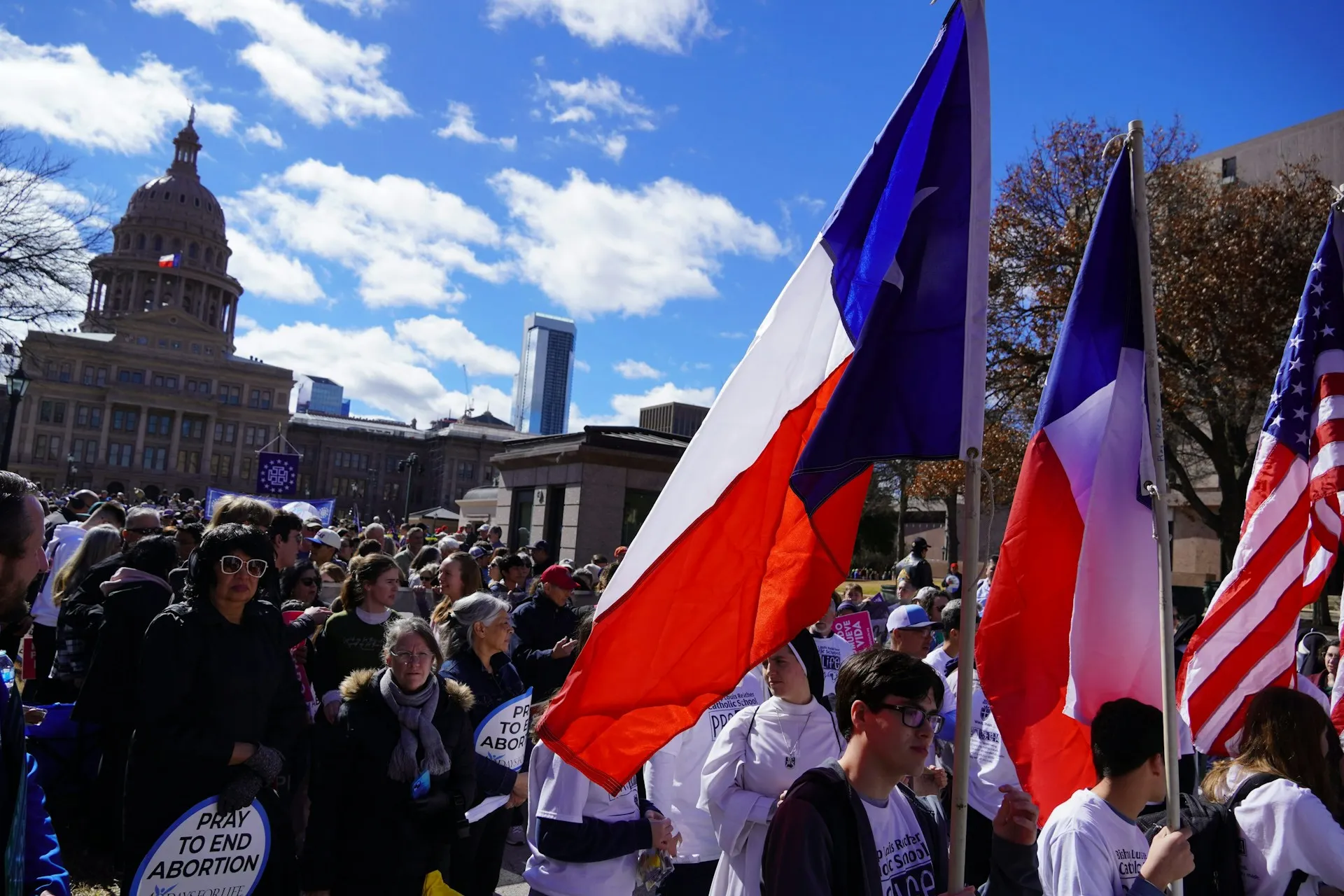
The topic of partisanship in American politics has been weighing on me for years. Consider, for example, how Republicans and Democrats approach the issue of abortion.
In 1973, Roe v. Wade guaranteed a nationwide right to abortion. At the time, there was a greater diversity of opinions around abortion: the Southern Baptists, for example, were fairly permissive, and neither the Republican nor the Democrat party were strongly affiliated for or against. Over the following years, however, religious and political opinions crystallized. Since then, almost without fail, the Republican party’s message has been along the lines of, “Vote Republican, so we can overturn Roe v. Wade and stop those evil, baby-killing Democrats.”
Also since then, almost without fail, the Democratic party’s message has been along the lines of, “Vote Democrat, so we can protect Roe v. Wade and stop those evil, women-hating Republicans.”
In reality, of the sixteen justices appointed since 1973, eleven were appointed by Republican presidents, but Roe v. Wade was not overturned for almost fifty years:
| Democrat appointees | Republican appointees |
|---|---|
| Ruth Bader Ginsburg (1993-2020) | John Paul Stevens (1975-2010) |
| Stephen Breyer (1994-2022) | Sandra Day O’Conner (1981-2006) |
| Sonia Sotomayor (2009-) | Antonin Scalia (1986-2016) |
| Elena Kegan (2010-) | Anthony Kennedy (1988-2018) |
| Ketanji Brown Jackson (2022-) | David Souter (1990-2009) |
| Clarence Thomas (1991-) | |
| John Roberts (2005-) | |
| Samuel Alito (2006-) | |
| Neil Gorsuch (2017-) | |
| Brett Kavanagh (2018-) | |
| Amy Coney Barrett (2020-) |
It turns out that we don’t actually elect justices, and the pesky thing about having an independent judiciary is that judges mostly try to do what they think the law says instead of what you want them to do. (In fact, it’s considered a breach of judicial ethics for a judicial nominee to promise to rule or not rule in a certain way – that’s considered to be compromising their rulings in exchange for political support.) Both parties, it seems, were making promises – or threats – that they couldn’t carry out for almost fifty years.
In 2022, thanks to a complex confluence of events1, Roe v. Wade was finally overturned in the Dobbs v. Jackson Woman’s Health Organization case. Since then, pro-life measures have suffered an almost unbroken string of defeats at the ballot box:
-
In 2022:
-
In 2023:
- In Ohio, in August, the Republican Party pushed for an amendment to raise the threshold for future amendments from 50% to 60%. This was widely understood as an attempt to make a future pro-abortion state amendment harder to pass. It was rejected.
- In Ohio in November, the amendment guaranteeing a right to abortion passed.
-
In 2024:
- Arizona, Colorado, Maryland, Missouri, Montana, Nevada, and New York all passed amendments guaranteeing a right to abortion.
- Nebraska had two competing measures: a ban after the first trimester passed with 55% of the vote, and a right to abortion until viability failed with 49% of the vote.
- In Florida, an amendment guaranteeing a right to abortion got 57% of the vote, but Florida requires 60% for constitutional amendments.
- In South Dakota, restrictions on abortion failed.
Additionally, Democrats did unexpectedly well across the country in elections in the aftermath of Dobbs. This is a nearly unbroken string of losses at the ballot box for the pro-life movement.
In all the arguing between the baby-killing Democrats and the woman-hating Republicans, many of us let ourselves forget that overturning Roe v. Wade wouldn’t outlaw abortion; it just returned it to the voters, and the pro-life movement didn’t have nearly enough popular support to accomplish much there.
But the ballot box isn’t the whole story. In state courts and legislatures, the pro-life side has some wins, and several red states had preexisting “trigger laws” that went into effect as soon as the Dobbs ruling came down. This shows that there was some truth to the Republicans’ pledge to stop the baby-killing Democrats, right?
Tracking abortion rates in the US over the years is surprisingly hard: the two most commonly cited sources, the CDC and the Guttmacher Institute, both have gaps in their data, and their methodologies differ, and the CDC changed its methodology in 1998, and Guttmacher changed to a new dataset in 2022. But, although it’s hard to cite a single authoritative number, it’s clear that abortion has noticeably increased since Dobbs. There’s evidence that, without any pro-life legislation, it would have gone up more, but this doesn’t seem like a ringing validation of the Republicans’ promises and the Democrats’ threats.
And, since Dobbs, the Republican Party has backpedaled hard on the issue of abortion. (I’ll write more about this in the future.) Is a more accurate promise, “Vote Republican, so we can overturn Roe v. Wade and then chalk it up as a win so that we don’t lose too many moderate voters by continuing to oppose those evil, baby-killing Democrats”?
Take another look at that chart: After Roe v. Wade, abortion rates stabilized under Reagan and declined under every presidency after his for the next 28 years. They tended to decline more under Democrat presidents, and they declined the most under Obama. There were no doubt several factors at play, but one of the largest appears to be the Affordable Care Act. Numerous studies show that abortion rates correlate with poverty: women are more willing to carry a baby to term if they’re not worrying over whether they can make ends meet, and the ACA’s provision of health care for wanted pregnancies and contraception to avoid unwanted pregnancies made a big difference.
Meanwhile, the evil, baby-hating Democrats point to serious moral issues of their own: horrifying stories of back-alley abortions, the heartbreaking circumstances that prompt some women to seek late-term abortions, the dramatic increase in maternal deaths from post-Dobbs abortion restrictions that fail to adequately protect the life of the mother.
Perhaps the most honest claim is, “Vote Republican, so we can attempt a decades-long effort of trying to get enough justices onto the Supreme Court to overturn Roe v. Wade, then we’ll have an even harder effort to persuade voters to enact laws to restrict abortion, but if you vote Democrat, it may turn out that they have some good ideas, too. It’s complicated.”
To their credit, serious pro-life activists recognize this. John Seago, legislative director of Texas Right to Life and an ardent opponent of abortion, said, “We’re concerned about not just saying no to abortion but supporting women who are facing unexpected pregnancies or other difficult circumstances. That needs to be the pro-life vision for the state of Texas. Part of our core agenda every session is increasing funding to these programs that support women and their families. We are the organization that drags Republicans, sometimes kicking and screaming, into investing more money into social services for pregnant women… The Republican Party does not have 100 percent of my support. There are areas where I think their policies and priorities are hurtful to human flourishing, and actually unethical.” Activists such as Marjorie Dannenfelser, president and founder of Susan B. Anthony Pro-Life America, said that overturning Roe v. Wade is only “the end of the beginning,” borrowing a phrase from Churchill.
And writers on both sides of the debate recognize the complexities. In Caitlin Flanagan’s “The Dishonesty of the Abortion Debate,”, she describes stomach-churning stories of women in the 50’s and 60’s using Lysol as an abortifacient, spurred by their own “whisper network” and by plausible-deniability ads from the Lysol company, and the resulting incidents of kidney and liver necrosis, emergency surgeries, and 50-66% maternal death. It was enough to make me want to be pro-choice. But then she writes: “What I can’t face about abortion is the reality of it: that these are human beings, the most vulnerable among us, and we have no care for them. How terrible to know that in the space of an hour, a baby could be alive—his heart beating, his kidneys creating the urine that becomes the amniotic fluid of his safe home—and then be dead, his heart stopped, his body soon to be discarded.”
Try finding a politician running for office who’ll talk this way.
You won’t win many elections like that.
I’m not trying to make some cynical “all politicians are liars” argument. But it’s a question of how are we being formed. Kyle Idleman calls this “the law of cognition” and the “the law of exposure”: “What you think about determines who you become,” and “What we are exposed to determines our thoughts.” John Mark Comer says it’s the choice between “unintentional spiritual formation” – being formed or deformed by “our habits, our relationships, the stories we believe, our environment, time, and experience” – and “intentional spiritual formation” into “apprentices” of Jesus 2. Paul calls it being “conformed to this present world” versus “transformed by the renewing of your mind” (Rom. 12:2). Our politicians, too, are being formed: by the need to solicit corporations and kingmakers for big-dollar donations; the need to market oneself to the base for small-dollar donations; the fear of getting primaried by someone more extreme than you; the pressures of catering to a news cycle that rewards outrage and sound bites and distorts and punishes thoughtful, nuanced takes; the lure of partisan news media appearances and social media virality that seems to offer a quicker path to recognition than the hard, thankless work of legislative compromise; the temptation to view your political opponents not as fellow Americans with whom you have to work, not merely misguided, but actively evil. Small wonder that the baby-killing Democrats’ and women-hating Republicans’ messaging ends up so divorced from reality.
And we get sucked right along into it after them: following the news cycles, listening to the outrage machines, rewarding the sound bites, tuning out the hard and boring work. Being cognitively exposed to anger and half-truths and manipulation, unintentionally spiritually formed, conformed to the pattern of this world. Believing our favored politicians when they say that they have all the right answers. Demonizing our political opponents instead of recognizing that they, too, are sinners made in God’s image, capable of good as well as bad. Believing that, if we vote for the right politicians and hate who we’re supposed to hate, then righteousness will reign and all our ills will be fixed and the nation will be made well.
Please understand: I am not saying that the two parties don’t differ on matters of abortion. I’m not saying that it doesn’t matter, from a pro-life perspective, who you vote for. But we have to do better than this. If we care about a cause – if we believe that, as representatives of the kingdom of God, we ought to work toward a particular end on earth – then it’s incumbent on us to do the work of wisely determining what that looks like, instead of uncritically going along with whatever partisan messaging best fits our tribe or our prior assumptions. We need to point to the goodness and wholeness that God offers in Christ, rather than merely vilifying our temporal opponents. Sometimes that may mean voting for one party; sometimes it may mean voting for the other. Sometimes it may mean not voting for a party, strategically withholding our vote so that an electoral defeat will push them in a direction more willing to work with us.
And sometimes it may mean turning off the news and signing off social media and doing the work yourself of loving your neighbor. Voting is important, but I daresay that a few hours of volunteering at a crisis pregnancy center would do more for the pro-life cause than a hundred social media posts or than being one out of millions of voters at the ballot box.
If you’re interested in learning more about a better, more Christian alternative to this partisan approach to politics, I encourage you to look at The After Party. I’ll also write more about this topic in the coming weeks.
Footnotes
-
Justice Ruth Bader Ginsberg rejected pressure to retire while Obama could nominate her replacement, despite her being 83 years old at the end of his term. Justice Antonin Scalia unexpectedly died in February 2016, ten months before the 2016 election, and Senate Majority Leader Mitch McConnell refused to hold a confirmation hearing for the replacement who Obama nominated, saying it was too close to the 2016 election. Donald Trump pulled an upset win over Hillary Clinton in 2016. Ginsberg died of pancreatic cancer in September 2020, and McConnell played even more aggressive politics, rushing Amy Coney Barrett’s confirmation through a mere two months before the 2020 election. All of these events, it seems, were necessary to gain a 6-3 conservative majority when Dobbs v. Jackson Woman’s Health Organization reached the court in 2022, and reporting suggests that the Court may have upheld a right to abortion without that strong majority. ↩
-
“Practicing the Way Course Teaching Notes,”, sections 2 and 3. ↩