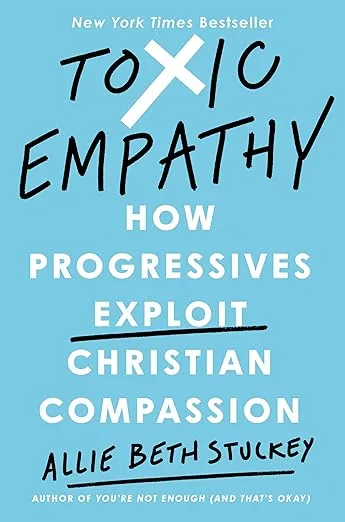
There’s an argument within some circles of Christianity that empathy is wrong: that it causes us to enter into others’ potentially immoral state instead of standing firm and reaching out from our own position of security in the truth; that it tempts us to compromise our beliefs and values in the name of others’ feelings; that it’s used to manipulate and pressure people into affirming immoral choices.
Thankfully, Toxic Empathy, by Allie Beth Stuckey, is not that book.
Empathy, Stuckey says, is a good thing: she defines it as “the ability to place yourself in other person’s shoes–with or without having had a similar experience” and says it acts as
A powerful motivation to love those around you. It precludes unfair criticism and presumptuousness and motivates us to help people who need it… This isn’t so different from Jesus command to “Love your neighbor as yourself” (p. xi).
Stuckey points out, correctly, that Jesus himself as our high priest empathizes with our weakness (Heb. 4:15). However, she says, “empathy alone is a terrible guide… Like all emotions, [it] is highly susceptible to manipulation” (p. xii). When it’s “hijacked for the purpose of confirming well-intentioned people to particular political agendas” (p. xii), the result is toxic empathy: using empathy to insist that “we must not only share [others’] feelings, but affirm their feelings and choices as valid, justified, and good” (p. xiii).
Toxic Empathy looks at five specific areas where Stuckey argues that this is happening: abortion, transgenderism, gay marriage, immigration, and social justice. In each of the five chapters, Stuckey tries to demonstrate genuine empathy for people on the other side of the debate; each chapter opens with a story such as a pregnant woman whose baby has a terminal birth defect, a Latina mother facing deportation, or a young black man killed by police. She tries to deal respectfully with Christians who disagree with her. Some Christian writers and speakers seem focused on condemning the bad, but Stuckey tries to conclude each chapter by pointing to the good: the value of human life, the goodness of God’s design of man and woman as reflecting his image, the justice and order that we seek to honor God, and so on. She concludes the book with a stirring vision of creation restored, with “no more debates, no more politics,” when all is made right (p. 168-169).
The inside flap of Toxic Empathy says that it “isn’t about doing away with empathy altogether; it’s about submitting our empathy to factual data, rational arguments, and biblical truth.”
Unfortunately, this is not that book, either.
I’ve just written about how being faithful to Scripture means more than quoting a bunch of Bible verses. But it seems fair to say that “biblical truth” doesn’t mean less than quoting Bible verses. The portions of Toxic Empathy that directly engage with Scripture – that cite specific verses and passages in support of Stuckey’s arguments – make up only about a page or two per chapter. The book is relatively short (170 pages), and any one of its five topics could easily fill multiple books by itself, so its treatment of each issue necessarily limited. I don’t automatically expect, for example, an analysis of what arsenokoitai means in 1 Cor. 6:9-11, an exploration of the ancient Hebrew ideas of gender that underlie Genesis 1, or a fully developed theology of political engagement that addresses how to deal with immigration or social justice. But five to ten pages is sparse regardless of how you look at it. Far more of the book is devoted to other arguments: graphic details of the medical practices involved in late term abortions, lists of complications from hormone therapy, descriptions of gender reassignment procedures such as vaginoplasty and phalloplasty, stories of women murdered by illegal immigrants, the sordid history of figures like birth control advocate Margaret Sanger or early gender researchers, anecdotes of people who were on Stuckey’s podcast, and so on.
These aren’t primarily factual data and rational arguments. For example, Stuckey avoids, apparently deliberately, sharing that late term abortions only make up 1% of abortions.1 Instead, the goal of her vivid descriptions of late-term abortions’ poisons, dismemberments, and death throes seems to be for our empathy for the unborn babies and our horror at their deaths to override any empathy for the pregnant women. (“I don’t think we will ever know the horrific sights and sounds in the womb during an abortion. I think we’d go mad if we did” (p. 7)). An anecdote about someone who found fulfillment in detransitioning serves as a counterargument to anecdotes about people who find fulfillment in transitioning. A tragic story of a surrogate mother with cancer serves as the linchpin of an argument against surrogacy for gay couples. Stuckey shares many statistics on crime by illegal immigrants, but she explicitly declines to explain those statistics and place them in context (“we really have no way of knowing” if illegal immigrants commit less crimes (p. 107)), and she explicitly presents empathy for murder victims such as Kate Steinle, America Thayer, and Laken Riley as a counterargument to progressives’ demand for empathy for immigrants (p. 103).
To be clear: I do not think that empathy-based arguments are wrong. I believe that God gave us both reason and emotion. As Blaise Pascal said, “The heart has its reasons of which reason knows nothing.” Our emotions can be manipulated or misdirected, but our reason can be no better: “The human mind is more deceitful than anything else. It is incurably bad” (Jer. 17:9). There’s seemingly no limit to our capacity for rationalization, and sometimes facts and rational argument become merely tools to more sophisticatedly deceive ourselves. It’s true that, as Stuckey argues, our empathy and emotions may tempt us to try and “be nicer than God” (p. 167), refusing to stand up for what we know to be true. But there are also times when we may intellectually justify wrong beliefs or actions, and it’s empathy and emotions that show us where we fall short of Christ’s love. God created us for relationship, and so empathy – the capacity to enter into the feelings of another person – may be a key part of how we grasp at truth. We seem to be wired to interpret meaning through story, so anecdotes – other people’s stories – can be powerful. But this isn’t the approach that Toxic Empathy claims to be taking. Instead, it promises to offer “commonsense, biblical truths” (p. xvii) as an antidote to being led by emotion, then in its main body offers a lot of emotion mixed with some factual arguments and only 5-10 pages of direct engagement with the Bible.
It’s worth pointing out that, on each of the five topics, Stuckey picks what might be called an almost maximally conservative position. Not only should Christians seek to outlaw abortion (with exceptions if the mother’s life is at risk), but some Christians’ “holistic pro-life” approach (seeking to care for mothers and others who are powerless or victimized and arguing that providing more support for mothers may be more effective than seeking legal restrictions around abortion) is a “lie” (p. 17-18). Christians should uphold the traditional view of male and female and refuse to use others’ preferred pronouns; even using terms like “biological woman” or declaring your own pronouns is participating in the lie and “giv[ing] an inch to the madness” (p. 61).2 Christians should uphold the traditional view of marriage and oppose legalizing gay marriage, since that’s “institutionalizing sin” (p. 90). On immigration, we should seek a “nonporous” border “that’s guarded by impenetrable structures and armed guards,” with “strict” enforcement of “laws against both illegal entry and illegal presence” (p. 113). (I understand this to mean mass deportation.) We should accept refugees, asylum seekers, and legal immigrants (p. 127) but must be cautious of immigrants “undermining” our culture (p. 137). Even relatively modest Christian suggestions such as having a more welcoming attitude toward refugees or preserving programs like DACA are rejected and lumped in with open borders advocates (p. 125). The chapter on social justice touches on a number of subjects (Black Lives Matter, police reform, equity, reparations, soft vs. hard on crime, racial reconciliation within the church, socialism, and the death penalty) and has fewer concrete prescriptions, but it argues that it’s “extremely unlikely” that police actions were caused by racism (p. 141), “disparities” do not mean “discrimination” (p. 141), it’s fundamentally unjust to treat one group differently than another or to make one individual bear any guilt or responsibility for others’ actions, and many efforts at racial reconciliation are wrong because they instead cause disunity.
I have plenty of disagreement with some of these views, but that’s fine – Stuckey’s a sister in Christ, they all fall within the broad circle of Christian orthodoxy, they’re all positions that can be reasonably debated in a democracy. I’m more concerned with the approach that she takes toward the views – even besides my above concerns regarding “biblical truths” versus empathy and emotion. This is best demonstrated with a quote from Toxic Empathy’s conclusion:
Whether suffering under Nero or Newsom, Christ’s followers can stand firm against the chaos of the world. (p. 166)
I laughed out loud when I read this. Nero was a “tyrannical, self-indulgent, and debauched” emperor who killed his mother, possibly killed two wives and a step-brother, castrated a young man and turned him into a replacement for his second wife, and was accused of burning down Rome. Governor Gavin Newsom of California went to a dinner party during COVID lockdown, is pro-choice along with roughly 170 million Americans, and is moderating on crime and LGBT. Christ’s followers under Nero were killed by the hundreds – torn to pieces by dogs, burned alive, and crucified. Christ’s followers under Newsom enjoy the robust protections of the American legal system, which political commentator and former religious liberty lawyer David French explains are “stronger than at any time in American history.”
This is by no means an endorsement of Newsom. But it’s absurd to put him in the same sentence as Nero (unless that sentence is some variation of “Newsom is nothing like Nero”). The only way I can make sense of it – the only way I can understand someone writing that sentence unironically – is if they’re is so used to thinking in terms of progressives versus conservatives, so convinced that progressives’ positions are bad and conservatives’ positions are good, and so marinated in stories of the crazy progressive political stuff that goes on in California that California is practically a byword for anti-God immorality in the 21st century, just as Babylon was in the first century. (See 1 Pe. 5:13 or Rev. 18:2.)
I say this because I’ve spoken of California in that way myself. It’s something that the evangelical subculture in America can do without too much trouble.
This partisanship, in my mind, is a more serious issue than the relative page count of Bible versus empathy and emotion. The Bible “is living and active and sharper than any double-edged sword, piercing even to the point of dividing soul from spirit, and joints from marrow” (Heb 4:12). As I wrote in the past, “I am a sinner. If I hold the Word of God up to my life, I expect to be cut – to see actions and beliefs in my life where I fall short of God’s standard. If I hold the Word of God up to a secular organization like the Republican or Democratic party, I expect it to cut even more.” But, for Toxic Empathy, the sword cuts in only one direction. Although Stuckey says that not “every Republican policy is good or every Democratic policy is evil” (p. 161-162), I don’t think the book has a single word of criticism for any Republican or conservative politician, position, or action.3
Partisanship can blind us to the “commonsense, biblical truths” that Stuckey and we seek, and I fear that it’s done this in Toxic Empathy. A few examples:
- “Toxic empathy demands our empathy only go one direction–toward the party the progressive worldview deems oppressed” (p. 103). When I first read this, I was surprised: if there’s a tension between “grace and truth” (Jn. 1:14) and “speaking the truth in love” (Eph. 4:15), then it’s probably fair to say that conservatives are more likely to err on the side of truth, upholding dogma and orthodoxy while falling short of Christ’s radical love, while progressives are more likely to err on the side of love, watering down God’s truth in an effort to be loving and nice. But privileging emotion over truth seems like a common human pitfall; can we really say that the misused, toxic empathy that Stuckey identifies is only and always employed by progressives? Her introduction, though, explains this: she defines toxic empathy as when empathy is “co-opted by the progressive wing of American society to convince people that the progressive question is exclusively the one of kindness and morality” (p. xii). It turns out that it’s easy to say that only your political opponents are guilty of a particular failing when you define that failing to only include your political opponents.
- “The uncomfortable truth is: we just don’t know” if racism is currently a problem among the police (p. 139). This is in a section titled, “The Myth of Systemic Racism,” introduced with the claim that social justice makes “assumptions that are simply not true” (p. 138), which suggests that we do know.
- Social justice activists’ accusation that police are racist because of some police departments’ historical origins as slave patrols is apparently not even worth a rebuttal (p. 134-135). Yet the history of figures such as Margaret Sanger 4, Thomas Malthus, Alfred Kinsey, and John Money get several pages of treatment (about three times the amount given to relevant Bible passages in their chapters) to show “the dark history of abortion,” the “evil ideas” that are “inextricably intertwined” with it, and the “sickening roots” of transgender medicine (p. 13, 17, 47).
- In sharing stories and statistics of crime by illegal immigrants, Stuckey repeatedly emphasizes that “none of these crimes should have happened” (p. 107) and are all “preventable,” if only we enforced our immigration laws. However, in sharing statistics of black men shot by the police, she quickly pivots to statistics of police killed, “to get a sense of the scale of the problem” (p. 140), allowing merely that “it may be that these officers still made grave errors” (p. 141, emphasis added).
- Studies consistently show that immigrants commit crimes and are incarcerated at lower rates than native-born populations. Stuckey rejects this argument, stating without evidence that “we really have no way of knowing that since they are, by definition, undocumented and there are so many kinds of people entering every day” (p. 107). However, this unknowability of immigrant populations does not stop her from asserting without evidence that “the hordes of people on our southern border are almost all young, military-age men” (p. 105) and that “very few are true refugees or asylum seekers” (p. 126).
- Stuckey engages with an argument from pastor and author David Platt: “It’s troubling how Christians in our country are the most resistant to refugees in our community” (p. 125). She rejects this, quoting Twitter/X user @Disntr that “refugees” is a “leftist code word for ‘illegal aliens.’” She also writes, “As a Christian, I support accepting as many refugees… as we can thoroughly vet and approve” (p. 127).
- Stuckey describes Christian author Latasha Morrison as suggesting that Ezra and Daniel “demonstrate communal responsibility for a nation’s sins” (p. 150). Stuckey argues that this “seems to miss key distinctions… Ezra and Daniel were part of a covenant people, Israel… Neither white people nor white evangelicals are part of a distinct, covenant group.” Morrison is addressing Christians, so “white people” aren’t relevant – so Stuckey’s argument appears to be that white evangelicals are not part of a covenant people. This is a shockingly theologically ignorant view that goes against many centuries of Christian teaching – see, e.g., Heb. 8 or Mt. 26:28.
- Although she tries to speak respectfully of Christians who disagree with her, she regularly misrepresents them. Anyone who argues for moderation on immigration is implied to be in favor of open borders (p. 125) (a view that, in reality, is a fringe position even among liberals). Holistically pro-life activists who argue that providing more support for pregnant women would be more effective than legal restrictions on abortion are grouped with pro-choice activists (p. 27).
- In response to a common argument that abortions decline more under Democrats than Republicans, because Democrats do more to support women, Stuckey replies, “This is a classic correlation-causation fallacy. Democrat presidents don’t cause the lower abortion rate and Republican presidents don’t cause a higher rate, because presidents don’t make abortion policy.” This is a straw man (the argument is that broader social policies affect abortion rates, not that presidents make abortion policy). It’s also a bizarre argument: taken to its obvious and inescapable conclusion, she’s arguing in 2024 (the book’s publication date, after Dobbs made significant legal restrictions on abortion a live possibility) that we don’t need to worry about voting for a pro-life president because it won’t affect the abortion rate. I know Stuckey doesn’t believe this.
My point is not, “Toxic Empathy espouses certain ideas, and I believe certain other ideas, therefore it’s wrong.” My point is that, even if you take the book’s arguments on its own terms, they have serious flaws: inconsistent, self-contradictory, indulging in straw men and misrepresentations, seemingly interested in bolstering one political side and criticizing the other by any means possible.
I’m sorry to write this way. It always dismays me to see how much of Christian discourse online is Christians attacking each other for holding the wrong views. I apologize for contributing to that. But reading this book prompted a lot of thoughts, and sometimes spilling some digital ink is the best way for me to organize them.
Allie Beth Stuckey is my sister in Christ. She’s trying to use her gifts to argue for God’s truth and God’s love. She’s trying to point toward the good. I love that! The unity that we have in the body and through the blood of Christ is greater than any of these criticisms. I look forward to worshiping with her in the new creation that she so stirringly describes in her conclusion to the book.
But, like her, I want us all to live by God’s truth, and there are real flaws here that can hinder us from doing that.
Toxic Empathy opens its chapter on transgenderism with a well-known quote from Alexander Solzhenitsyn: “Even if all is covered by lies, even if all is under their rule, let us resist in the smallest way. Let their rule hold not through me!” But his other well-known quote is, I think, more urgently needed:
The line separating good and evil passes not through states, nor between classes, nor between political parties either — but right through every human heart — and through all human hearts.
Partisanship would have us draw that line between us and them. It would have us think that our political party or our tribe is good and the other is evil. But that’s rarely true. Even the best of us have sin in our hearts. Even the worst of us have, through God’s common grace, the capacity to do good. Even the wisest of us need the humility to realize that we may be wrong, that we may have blind spots where we’ve absorbed the wrong ideas of our culture, tribe, or party, instead of being formed by God’s truth.
As C.S. Lewis puts it in Mere Christianity:
The devil [is] getting at us. He always sends errors into the world in pairs – pairs of opposites. And he always encourages us to spend a lot of time thinking which is the worse. You see why, of course? He relies upon your extra dislike of the one error to draw you gradually into the opposite one. But do not let us be fooled. We have to keep our eyes on the goal and go straight through between both errors.
Footnotes
-
Stuckey cites a CDC statistic estimating 10,000 late-term abortions per year but omits that same source's comment that this makes up 1% of abortions. “Late-Term Abortion Was the Right Choice for Me,” by Meredith Isaksen, offers a heartbreaking account of one late-term abortion. Some women who seek an abortion after carrying a baby for 17-20 weeks do so because they either failed to recognize the pregnancy or lacked the means to get an abortion earlier, but others are wanted pregnancies in tragic circumstances (whether maternal health or fetal abnormality).
As pro-life Christians, we can advocate for the sanctity of human life, even in tragic circumstances. But focusing on the gruesome medical details of late-term abortion procedures feels cruel to women like Isaksen – it feels like turning their suffering and grief and into a talking point.
↩ -
Working as a software developer has shifted my perspective on declaring your pronouns. Thanks to virtual interactions combined with unisex names and nicknames, multicultural settings, and screen names, it may be far from obvious that someone named Alex Smith, @coffeecoder412, or Caihong Zhang is female. The field skews heavily male; getting regularly misgendered as a result of stereotypes is no fun and can leave women in software development feeling like they don’t belong. Normalizing explicit pronouns can be a way of making them more welcome. ↩
-
The closest she comes is in a discussion of Elijah McClain’s death in the chapter on social justice: “Elijah’s life was unnecessarily and unjustly taken by the very people who protect us, and he’s not the only one. Every year civilians are the victims of undo force by police officers… America’s history is riddled with racial discrimination” (p. 130-131). Since this is part of the chapter’s pro-empathy opening story, presented from a more progressive perspective, it’s not clear to me whether she believes this herself. Elsewhere, she’s careful to shield police offers from criticism: “Elijah’s story reads like a case of deadly bullying.” George Floyd was “subdued” (not killed) by the police in a way that “appeared to be inhumane.” It “may seem” that “we [should] want to build a world in which Elijah and others like him are treated equally and justly.”(p. 132, 141, xx, emphasis added throughout). ↩
-
While here, I’ll note that Stuckey’s treatment of Sanger has some mistakes. Margaret Sanger, a pioneering advocate for birth control and the founder of Planned Parenthood, had serious flaws: she endorsed the Supreme Court’s reprehensible Buck v. Bell decision that authorized forced sterilization, and, like a very large number of people of her era, she encouraged eugenics. But, contrary to to the claims of Toxic Empathy and some other modern critics, Sanger was an opponent of the Nazi party and was an ally of civil rights leaders; accusations that she was racist are based on a misreading of her letters. See here for more information. ↩