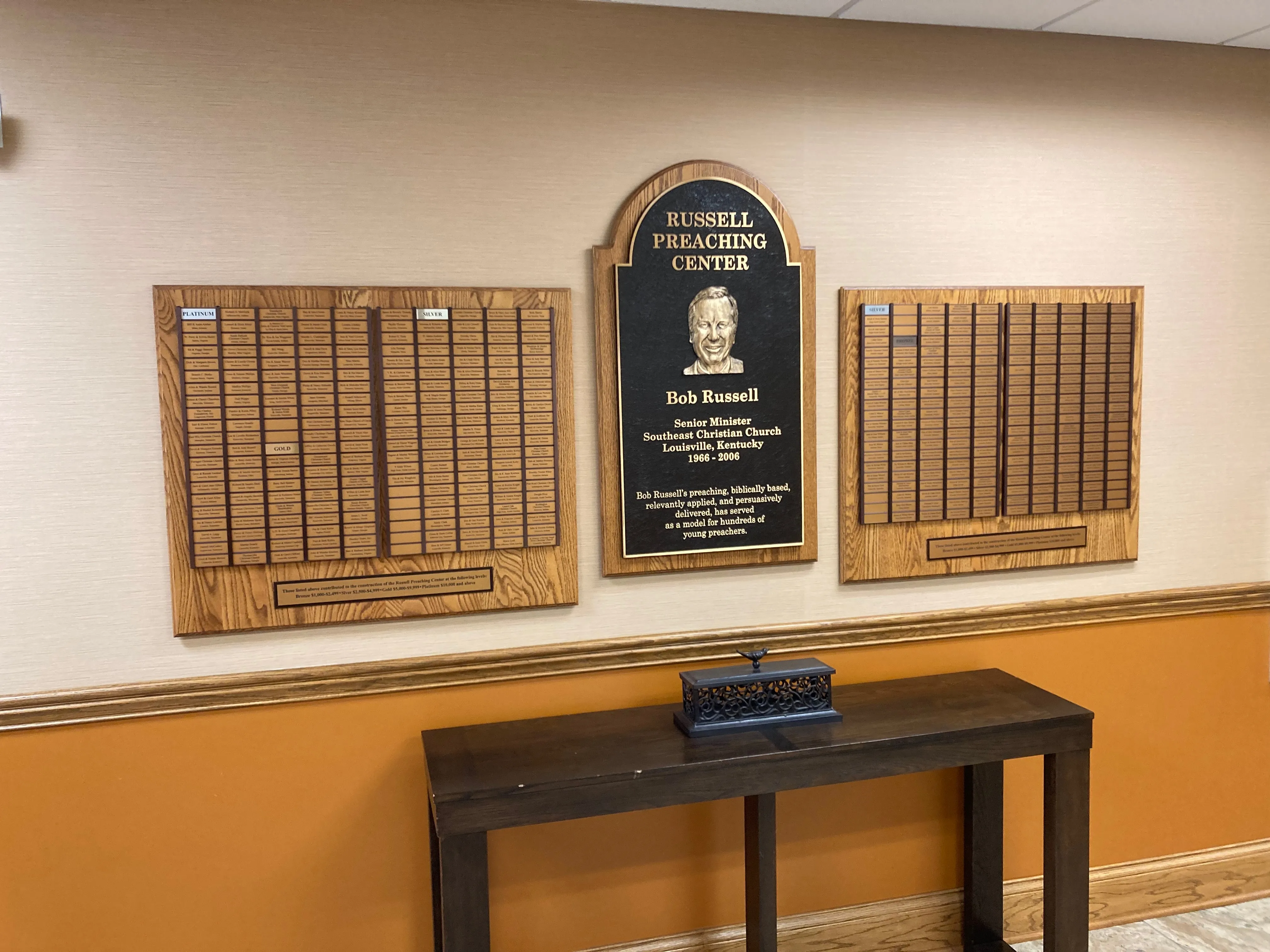
“This is the Bob Russell Preaching Center,” the college student explained to the group of high school students and their parents on the Johnson University campus tour. “It was named after Bob Russell, who donated a bunch of money for the center.” I couldn’t help but chuckle inwardly; I knew enough of the college’s history to know this wasn’t accurate.
Bob Russell was huge. The center was named after him because he was one of the biggest preachers of his era. At age 22, he became the preacher at Southeastern Christian Church in Louisville, Kentucky, a church of 120 members. He ministered there for the next 40 years, during which Southeast grew to 18,000 people, becoming one of the largest churches in America. Since his retirement from Southeast in 2006, he’s continued to write, mentor, preach, and speak. During my time at Johnson University, he was a bona fide celebrity, known and looked up to by most everyone at the college.
It seemed that this student had never heard of him.

I was reminded of that event this week. Elisabeth Elliot had been in the news, or at least the corner of the news represented by the intersection of online discourse and American evangelicalism, because of her portrayal in a couple of recent books. I was talking with my kids about the stories. One of them texted me, “I guess she was a pretty big deal?”
She was huge. I’m not that familiar with her work (she seemed to write more for women, and parts of the evangelical subculture can be fairly gendered), but she wrote over 20 books, served as a missionary for years, consulted on the translation of the New International Version, and widely spoke. Her first husband, Jim Elliot, was something of a hero to me, to many of my generation, and to many of the previous one or two generations. He was one of five missionaries (including their pilot, Nate Saint) speared to death in 1956 during an attempt to reach the Waorani people in Ecuador. After his death, Elisabeth Elliot and Rachel Saint (Nate’s sister) lived and worked among the Waorani and helped bring many of them to Christ. Elisabeth later wrote the story of Jim’s life, based in part on his journals and letters, and published it as Shadow of the Almighty. I read it in college and found it profoundly moving. Jim’s quote, “He is no fool who gives up what he cannot keep to gain what he cannot lose,” inspired countless Christians to live more wholeheartedly for Christ. I also had the privilege of hearing Steve Saint (Nate’s son) while I was in college. The full auditorium hung on his every word.
All of my kids, who are voracious readers, have grown up in the church, and have gotten or are working on Bible or ministry degrees, had never heard of her.
How could people so influential, so well-known, so widely respected go to complete unknowns in a single generation?
Maybe we’re too fragmented. Just as the expense of setting up broadcast towers meant that most people got their television news from one of three major networks, the expense of running printing presses meant that many Christians were shaped by institutions and publications such as Christianity Today or (within the church tradition I’m a part of) Christian Standard and the ecosystem of publishers and books around them. Now, as digital technology drives the cost of creating and reproducing content to nearly zero, there’s an explosion of authors, bloggers, influencers, content creators, YouTubers, and podcasters. The result is an increasingly fragmented, even atomized, landscape. In “There Will Never Be Another Billy Graham,” Bonnie Kristian talks about her time at Christianity Today (CT):
When I introduce myself to people and tell them where I work, even among Christians I sometimes get a blank stare. For a long time, my instinct was to add that CT is a magazine founded by Billy Graham. But lately I’ve given that up, for I find that at the mention of his name the blank stares do not turn to expressions of recognition…
Consider: Around the time Graham helped found CT, he filled New York’s Madison Square Garden for sixteen weeks. Hours of his preaching ran on ABC News, and The New York Times would simply print his sermons. When demand for his message exceeded what the Garden—which seats around twenty thousand people—could accommodate, Graham moved over to Yankee Stadium and packed that too.
Now, there’s no critical mass of people to gather around someone like Billy Graham, when they instead could go online and follow anyone from Joel Webbon to Allie Beth Stuckey to Josh Howerton to April Ajoy to Brandan Robertson. I suspect that some or all of these names may be unfamiliar to readers, which helps prove my point: Almost all have published books, each has tens of thousands to millions of followers, each has millions of views or listens, each has become the subject of vigorous debate in their respective corners of the ecosystem, and each may be unrecognizable to an American Christian selected at random.
Maybe we’re not doing a good enough job of passing along to the next generation. Some Christian traditions have just finished celebrating All Saints’ Day, remembering and commemorating the saints who’ve gone before us. The practice of canonizing specific saints and venerating them is found nowhere in Scripture, but the Bible does have a great deal to say about looking to past believers as examples of faithfulness. Besides the great “hall of faith” of Hebrews 11, the Bible presents as examples Paul and his coworkers (1 Cor. 11:1, Phil. 3:17, 4:9; 2 Thess. 3:9); local church leaders (1 Pe. 5:3, 1 Tim. 4:12); and past kings, both well-known (2 Chron. 17:3, 34:2) and less so (2 Ki. 14:3, 2 Chron. 26:4). I know that in my own walk with Christ I’ve been inspired by the example of past believers such as William Tyndale, George Müller, Dietrich Bonhoeffer, Cameron Townsend, and Jim Elliot.
There is a strength in learning our history: We can learn from the past and draw strength from the example of those who’ve gone before us. History anchors and orients us, reminding us of our connection to something bigger than ourselves and of our duty to pass that on to those who follow us. And, as recognized at All Saints’ Day, Christians in particular can recognize our connection with those who’ve gone before us: if Christ conquered death on the cross, and if Christ’s blood brings unity to the church, then that unity can apply across time and mortality as well as across space and ethnicity. So death need not break the unity of the body of Christ, and the church triumphant (those believers who await in Heaven for the new heavens and the new earth) remains one with the church militant (we soldiers of Christ on earth). Hebrews 12:1 says that we are surrounded by a great cloud of witnesses, using the imagery of spectators watching us running a race. We need not reduce that to a figure of speech.
I’ve previously discussed the suggestion that religious faith within a family follows a regular pattern: The initial converts of the first generation are active and passionate in their faith. Their children, the second generation, inherit their parents’ faith; they’re still active, and their faith is still meaningful, but they lack the firsthand commitment and passion of their parents. As a result, in the third generation, religion is more of a formality, just going through the motions. The fourth generation then leaves the faith completely. This pattern underscores the importance of each generation making that first-generation passion their own and passing it on. But perhaps, even among those who do pass a vibrant and living faith on to their children, there can be a failure to pass on the history and traditions that surround and support that faith: the Bob Russells and Billy Grahams and Jim Elliots.
And all of this, I suspect, is greatly complicated by a culture that, thanks to technological changes and demographic shifts, seems to change faster than ever. The same digital transformation that fragmented the present landscape also makes it harder to hang on to the past.
But maybe our regard for our heroes was never as pure as we might have wished. Let’s talk a bit more about Bob Russell.
There was a great deal to admire about him. I had the blessing of hearing him preach two or three times. Each time, he was an excellent communicator and an excellent preacher. He preached the Bible, clearly, eloquently, and compellingly, without watering down Scripture or resorting to gimmicks to keep people entertained. He seemed to avoid a lot of the pitfalls of celebrity pastors: He spoke openly about his support team that made his sermons possible, instead of acting like it was all his own talent and effort. He deliberately brought in other ministers to work alongside him so that Southeast Christian Church wouldn’t be defined by his own persona.
And yet, if I’m honest, I worry that the high regard that my contemporaries and I had for him was not purely because he was a “good and faithful servant” (Mt. 25:23) who pastored his church well. At a Christian college full of people studying to enter the ministry, who cared about seeing God’s kingdom advance on the earth, it was hard to avoid feeling pressure to grow churches bigger, feeling like what counted were big numbers – and the church where Russell preached was one of the biggest. And, as members of the independent Christian Churches/Churches of Christ, we (or at least I) were uncomfortably aware that our churches had gone from a dynamic movement in the 19th century, passionately pleading for the unity of Christ’s church to reach the world, to one that had split three ways, comprising a tiny minority of American Christianity. (In 2000, around the time when I heard the most about Russell’s popularity, we were about 0.5% of the American population, so maybe 0.6% or 0.7% of American Christians.) Russell’s success showed that we, too, could become a megachurch. As Donald Miller puts it, “We are, perhaps, even more obsessed, in the church, with the stuff culture is obsessed with. We are hardly presenting an alternative worldview. The matra [sic] seems to be ‘Trust in Jesus! He will redeem you to the world.’” 1
The recent controversy around Elisabeth Elliot represents another pitfall of how we treat our heroes. Debate around her life and legacy has sprung up, first because of ongoing debates about evangelicalism as a movement has treated women, and second because of recently publicized speculation about her sexuality. I don’t have any unique contribution to make to that debate, but I find the mere existence of the controversy noteworthy. When a beloved figure of the past is criticized, many of us feel instantly defensive. Some of this, no doubt, comes from a desire for the good: wanting to think well of and defend people we care about (and, as recognized on All Saints’ Day, people with whom we still share a bond), wanting to see people sanctified by the Spirit, wanting to see God’s good made manifest in people’s life. Some of it is simply the Christian principle of charity, wanting to speak well of people and not wanting to participate in gossip. But some of it, perhaps, comes from an unwillingness to honestly face humanity’s sinfulness. It’s far, far easier to mentally slot people into buckets of “good” and “bad” than to grapple with the full extent of sin as seen in our lives and others’. But it’s far better to take the approach of Dietrich Bonhoeffer: “Anybody who lives beneath the Cross and who has discerned in the Cross of Jesus the utter wickedness of all men and of his own heart will find there is no sin that can ever be alien to him. Anybody who has once been horrified by the dreadfulness of his own sin that nailed Jesus to the Cross will no longer be horrified by even the rankest sins of a brother.” 2 And, having recognized that sin, we can glorify God for his radical grace and his transforming power that works through us and in spite of us, and we can honor our heroes for their faithfulness despite their failings.
On All Saints’ Day, we Protestants pride ourselves on remembering that “saints” refers to all believers, that we have no need to set aside certain individuals as beatified souls who can intercede for us in Heaven. But, instead of saints, we sometimes appoint celebrities: people who we look up to for their fame, using them to justify ourselves to a dismissive or hostile world, or as sanitized symbols, to sidestep the messiness of following Christ as sinful human beings. To whatever extent we’ve done that to them, maybe they’re better off being forgotten.
And maybe the next generation is picking their own heroes. I don’t necessarily mean people like the Internet-famous voices I mentioned above - the Allie Beth Stuckeys and Josh Howertons and April Ajoys and the rest. I know that many people have found them helpful, and I have no doubt that God can work through them. But, to focus on the example of Josh Howerton: he’s a Southern Baptist pastor of a multi-site megachurch in the Dallas-Fort Worth area with 25,000 people. I didn’t know any of that prior to writing this piece; I only knew of “Pastor Josh Howerton” for the quotes and videos that I see circulating on social media. Brandan Robertson leads a church in Queens, but he’s best known as the “TikTok pastor.” In each case, “pastor” almost seems a non sequitur: the word comes from the Greek for shepherd, referring to an elder’s responsibility in shepherding the souls of his congregation (1 Pe. 5:1-4). You cannot shepherd the souls of people you’ve never met nor seen. If, in forgetting the megachurch pastor and author heroes of the past, we’re merely replacing them with celebrity pastor and influencer heroes of the present, that’s no advantage.
I’m meaning more the people in the current generation’s own lives. My kids hadn’t heard of Elisabeth Elliot, but they can speak of so many others: college professors and youth ministers’ wives and campus ministers and roommates and older church members who’ve poured into their lives and modeled what it means to know Christ and showed them love and helped shaped their faith. I don’t know anything about the college student who botched her description of Bob Russell, but the fact that she was giving a tour at a Christian college where she was pursuing a degree in Bible suggests that she could give her own list of heroes, mentors, and examples.
And, at the risk of contradicting what I just said about Internet-famous voices: my kids can also point to people they’ve never met. Although we often give too much weight to celebrity status, there are many authors, speakers, and commentators (even online!) who God has used to help his people. There’s a lot that could and should be said about the perils and problems of online ecosystems and interactions, and we at times make too much of the parasocial relationships with our celebrities, but the same blood of Christ that unites the church across space and time means that we do have a genuine unity with the authors and speakers who help guide our faith.
In my own personal list of past believers who’ve inspired me, I omitted a name: Fred Brooks. He’s known, not as a Christian pioneer, but as a computer architect for IBM. But the book he wrote from his experiences, The Mythical Man-Month, became widely influential for decades in the fast-changing field of software development. He naturally and seamlessly wove references to his faith throughout his work, concluding, “To only a fraction of the human race does God give the privilege of earning one’s bread doing what one would have gladly pursued free, for passion. I am very thankful” (p. 291). To me, he epitomized a Christian living faithfully, working with excellence, and as a result naturally and winsomely showing the beauty and joy of following Christ. Most Christians have never heard of him. And that’s okay. Faithful service is more important than fame. Making an impact within your own sphere is more important than being known to subsequent generations.
The heroes of the past generations still have a place regardless. My grandfather liked to tell a story of the fleeting nature of fame. As I recall it, he told of how the Roman orator Cicero, when offered to have a statue built in his honor, demurred. Cicero said that he would rather have people ask, “Why isn’t there a statue to Cicero?” than ask, “Who’s Cicero?” 3
My grandparents were, to many, some of these past heroes. My grandfather taught at Johnson University for 28 years, and he and my grandmother served others in countless ways. I’d be surprised if the student who gave us the campus tour could say anything about them. But that’s okay, because I know that several of those who are currently teaching at Johnson University did know them, and they were shaped by them, and now they’re shaping the students after them. And so the legacy of my grandparents – or, more accurately, the legacy of Jesus’ work and faithfulness through my grandparents’ work and faithfulness – lives on through them.
Similarly, the legacy of Bob Russell isn’t in some preaching students knowing why his name is on a plaque by their classrooms. It’s in the 18,000 people who gathered in his church every Sunday and in the preachers around the country who’ve been inspired by his example. Jim Elliot’s work lives on through his journals and through people like Steve Saint, but also through the Quechua and Waorani people of Ecuador who he and Elisabeth helped reach, and through the countless believers after him who he inspired to enter the mission field or to live more wholeheartedly where they are. Elisabeth Elliot’s work helped a generation understand femininity, the love between a man and a woman, and life in service to God, and that became part of evangelicalism’s efforts to follow God, even if later generations reevaluate parts of it, as believers, “always reforming,” strive to ever follow Christ more faithfully.
The heroes would like it this way. As these heroes of the past, the Elliots and my grandparents and Fred Brooks and Billy Graham and the rest, join the great cloud of witnesses, I cannot imagine that they mourn any loss of fame or recognition. They have received the “Good and faithful servant.” They have entered into their Master’s joy. They have given up what they cannot keep, whether at age 28, as with Jim Elliot’s martyrdom, or at age 99, as with Billy Graham after a long life of faithful service. Now they cheer us on as we “run with endurance the race set out for us, keeping our eyes fixed on Jesus, the pioneer and perfecter of our faith” (Heb. 12:1-2).
Footnotes
-
Searching for God Knows What, p. 211. Miller’s specific examples are of churches favoring the popular, the wealthy, or the physically attractive, but it easily extends to the famous and the numerous. ↩
-
Either my memory of my grandfather’s story is faulty, or his story was. The actual event is attributed to Cato the Elder, not Cicero, and the details differ: “I would much rather have men ask why I have no statue, than why I have one.” Either way, the stories’ discrepancies further show the limits of reputation and fame across generations. ↩